Friday, October 31, 2008
Happy Halloween!!!!!!
(i stole these jokes)
Q. What do goblins and ghosts drink when they're hot and thirsty on Halloween? A. Ghoul-aid!!!
Q. What is a Mummie's favorite type of music? A. Wrap!!!!!
Q. What's a monster's favorite bean? A. A human bean.
Q. Where does a ghost go on Saturday night? A. Anywhere where he can boo-gie.
Q. What did the skeleton say to the vampire? A. You suck.
Q. Why did the ghost go into the bar? A. For the Boos.
Q. Why was the girl afraid of the vampire? A. He was all bite and no bark.
Q. Why did the game warden arrest the ghost? A. He didn't have a haunting license.
Q. Why didn't the skeleton dance at the party? A. He had no body to dance with.
Q. Where does Count Dracula usually eat his lunch? A. At the casketeria.
Thursday, October 30, 2008
Graffiti clips to watch
banksy
graf featuring Miss 17
NYC bombers
Bombing in New York City
Graffiti Brooklyn
bombin' NYC
Urban Green
Wednesday, October 29, 2008
Readings for next week
Just a reminder that we will read and talk about The Pillowman next week and then move onto questions about stories created by and about graffiti.
Please see the External links page for the readings. The first reading will be an op-ed piece in the New York Times by Errol Morris who wrote (in my opinion) a fascinating analysis of a smile by Lynndie England who was part of the proceedings that happened in Abu Graib. In my opinion, The Pillowman raises many questions about the legality and the usefulness/uselessness of torture. Like everything else, it is a puzzle with no solution--we, the reader, need to figure out if the torture is (ever) justified. In the Morris piece, he does a wonderful reading of a smile and tries to understand if England is actually happy torturing these prisoners or if we cannot even trust our eyes in the photo. Please read/print it out and we will discuss it on Wednesday.
This will be our transition into our analysis of the story of graffiti. In the 21st century, writing is entering the virtual in leaps and bounds and technology is changing the way we write and read literature. But next week, we are going to analyze one of the oldest forms of writing known to mankind--graffiti. But this (illegal) practice has also been updated and the way we read graffiti is no longer just on the walls of our neighborhoods but virtually as well. So, for next week, I would like you to read an article that I am writing for an online journal entitled, “Bombing” Brooklyn: Graffiti, Language and Gentrification." It is a rough piece and still needs a lot of work but I think it is an introduction to graffiti (at least NYC graffiti) and also hits this idea about how graffiti is currently being transformed and used in ways that is very different from the way that it was intended. Please print this out and we will begin our conversations about this piece but hopefully we will get more into your ideas about writing and technology in the classroom.
I am flying tomorrow to Chicago for a conference and I will not be back until Monday. I will probably not have much access to the computer so I will not be updating my blog. But please continue to write and think through the meaning(s) of The Pillowman. Next week, I will also send you some graffiti clips that I want you to watch as well, so please keep looking at my blog for updates.
Good luck and take care!
Thoughts about The Pillowman (Part IV)
Monday, October 27, 2008
Thoughts about The Pillowman (Part III)
Act One Scene Two is a graphic and harrowing story about parent's setting up an evil experiment to see what type of literature a "loved" boy could produce while listening, for seven years, to the torture of another child in an adjacent room. Apparently, the result is that green pig stories get displaced by stories about razors in apples (if you read the play, you'll understand this last line).
And while in class, I do want to get into the story and hear your thoughts, I wish here to go back to my idea that I wrote previously about this play being a metaphor for a nation torturing its citizens (or enemy combatants) for the greater good of the nation as a whole. And I want to connect it to a question that you raised a few weeks ago--why so many stories about war and/or 9/11? Well, what type of stories are written by writers in the 21st century as smoke rises from the ashes of the world trade center or Larry King is talking about the U.S. military using water torture to extract information from suspected terrorists. What about us? When we overhear these conversations as we flip through the channels or watch SNL or John Stewart or read abstracts from newspaper articles--do these stories affect us as people? Does the fact that we know that people have been tortured or we see photos of American soldiers doing unspeakable acts in the name of our country affect the stories that we tell? Are we Katurain, living a nice life with luxuries (cell phones, new clothes, trips to the theater, dinner out) but we are still getting affected by it on another level?
Act Two Scene One The Pillowman Story
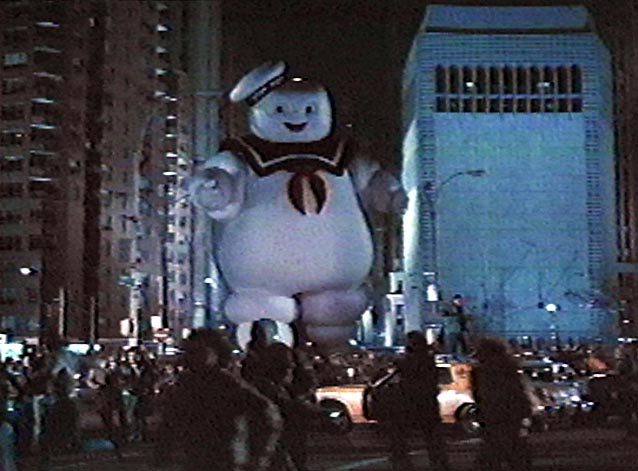
Okay, if truth be told, when reading this story I can't get the image of the the scene in ghostbusters where they fry the State Marshmallow Man. Anybody see ghostbuters? (on three, "who you goin' to call?"). But of course, in this play, the Pillowman is a lot more (deadly) serious. The Pillowman kills children before they begin leading horrible lives as adults. Again, it's this highly imaginative, in my opinion, fascinating story that gets me each time I read it. But as a metaphor, what does it mean? Is the Pillowman doing a tough but needed job--a person who can no longer live with the memories of molestation that happened to her when she was young, kills herself at 45 because her life has been awful and full of pain--well, here comes the Pilloman to save her before she becomes sad and abused. Objectively, is this a good thing (and this of course could lead to a three hour conversation). But if we table this discussion, could we maybe ask a question that I remember reading in a Stephen King book a long time ago that has stayed with me to this day--if you could go back in time and kill Hitler as a small child before he became the head of a state that killed millions of Jews, gypsies and homosexuals, would you do it? Would you be able to go back and kill a child? If we take this to a State level--what if we could find out who the eventual terrorists would be that would plant a dirty bomb in our streets? Would we be justified in arresting them now? Or, what if we believe that a state will attack us soon with nuclear or chemical weapons, would we be justified to order a pre-emptive strike? A country that has weapons that could eventually destroy us and blow us to smithereens is therefore always in the process of attacking us and therefore we are not actually attacking but defending ourselves when we invade another country?
These are of course really large questions here that I think the text, through the use of stories, is helping us think about and forcing us to question.
Good luck with the reading and I will write again........
Friday, October 24, 2008
Thoughts about The Pillowman (Part II)
So I have your midterms next to me and I will begin grading them shortly. Before I do, though, I do want to say that I have been impressed by the conversations that we have been having in class so far. I realize that the material that we have had so far has not been easy--and I make no apologies for this. As I stated on my syllabus, I expect us all to be intellectuals and to work through material that we may not like, may find tough, and that may find confusing. The goal of the first part of the semester was to read material that will make us think and see our post war(s) world a little bit differently. I know that I have a new understanding after listening to your comments about these texts, after seeing Blackwatch on stage, after reading your posts (so thank you). And I hope you do as well.
The second part of the semester, I hope, will be just as challenging as well as rewarding. Keep up the good work and keep fighting through these texts and bring your energy and intelligence to your posts as well as our discussions.
But now onto THE PILLOWMAN. Reading through the comments on various listserves about the play, a few words keep popping up--"brilliant" and "frightening." Well, after leaving the exam on Wednesday and hopping onto the G train to head home, I completely missed my stop because I was so wrapped up in this play. So, yeah, I agree--I think it is brilliant and frightening at the same time. But, it is also a play in which "the meaning" is just out of reach and no matter how much I stretch, it stays a fingertip away. You might find the same thing when you read. So what I will try to do a few times before our class meeting is to mention some large themes/ideas that I see and hopefully raise some interesting questions that could help you think with this material.
THE WORLD OF STORIES
Martin McDonagh is a playwright who, first and foremost, is a storyteller. He's the type of guy that you would picture in a small outoftheway pub in Ireland, sitting before a half drunk glass of Guiness and a warm peat fire, who suddenly clears his throat and two hours later after telling a fantastical story that seemed to just dance off his tongue, clears his throat again and stares at his beer never to say another word. A guy who contains many histories inside him and, given the right moment, will tell you things that you don't want to know but can't ever imagine getting up and just walking away. STORIES. The Pillowman, first and foremost, is a play that contemplates the art and nature of stories.
What does a good story do? A story contains a self-contained world that envelopes the reader/listener in a way that while s/he may feel the chair underneath her/him, there is a disconnect with the ordinary world and s/he enters completely and wholeheartedly into the world that is being created. It happens occasionally. The theater is a good place--the lights go down and the actors are mimicking opening letters (ala Blackwatch) and you know they are just actors but suddenly that doesn't matter and you are brought into the world of the fighters in Iraq. Or, for me for example, when I watched Children of Men and I forgot completely that there was anyone in the theater. Or...you get my meaning.
But a good story is not just about what it does to you in the moment of the telling. This is entertainment. Nothing wrong with that, of course, but a story must reach beyond the world it created and enter into our world. And that is what I think McDonagh does so well. I agree with Tupolski that all the stories within The Pillowman are "pointers" (17) and that they are trying to tell us something. But what are they pointing to?
Let's take the first story, "The Three Gibbet Crossroads" (17-18) where a man wakes up in a gibbet, knows he did something wrong, but doesn't know what. His crime is on a placard above the cage and so he cannot see what he did wrong. People pass by and everyone who sees him is disgusted by him (two other prisoners--a rapist and a murderer are forgiven by the passerbys) and eventually one even kills the man. Before he dies, the man wants to know if he will go to hell but he is just laughed at as his life drains from him.
Katurain says that this story is a great story because it is a puzzle without a solution.
Okay, so what do we do with this? Well, one, we look at the story aesthetically and, yeah, it's a good story. It gave me a few chills and will probably keep me up tonight. But on another level, I do think it's pointing to something as well. But what? Well, why is this guy in prison in the first place---because he did something horrible and is punished for it. But do we know this for sure? We, the audience, don't know his crime--or if he did anything at all. And the people--the nuns, the highway man--are disgusted by what the sign says. But did they see him do the crime (whatever crime it is)? No. All we know is that there is some power that was able to arrest, try and convict the man without any say on his part. He had no power of attorney, he had no defense, hell, he doesn't even know what he did. But as his life is spilling from him, he is convinced that he did something wrong and wonders about his eternal soul.........this sounds to me as a metaphor for a prison system in a State where people have no rights. A prison system where people are arrested without formal charges and are not given a chance to defend themselves. They are outside the law and therefore are not even able to get sympathy from passerbys. They are convicted and therefore seen as ultimate danger to the State and its subjects and therefore they have to be locked up and sent away (in this case forever).
Does this sound like anything we know? Is this story, a puzzle with no solution, actually pointing to our current post 9/11 world where governments have places outside of the law where, for the safety of the State's subjects, they are outside of all normal laws and legal processes? A place like Guantanamo Bay perhaps?
Is this play really a frank and brutal story about a world where governments are sanctioned to torture in order to protect? A play about what happens when laws are pushed aside for "national security?"
Maybe, maybe not, but as you read this play, think about what all of these stories point to? Who are the defenseless children in these stories? What do the two brothers represent? How is torture used in this story?
Anyway, that's probably too much for one sitting. I'll stop here. But I'll try to get some more ideas out here on my blog tomorrow.......
Thursday, October 23, 2008
Some initial thoughts about The Pillowman
Okay, so we are moving away from memoirs and plays and graphic novels about war and instead we are moving to . . . a play about child murderers?!?!
Yes, The Pillowman is about two brothers who are being accused and interrogated by two policemen for the gruesome murders of two children and the disappearence of the third. It seems as if one brother is a writer and many of his stories deal with kids who get killed...in many of the same ways that actual kids get killed.
So part of the pleasure (and yes, I say pleasure) of reading this play is to try to figure out if the brothers did it or not. And the play (in my opinion) is so well written that there are moments where I just want to put the book down in horror but many others where I actually laugh at a really funny line or forget about the play entirely and just get lost in the actual story that one of the characters recite. Again, not an easy read at all but a very interesting one.
But, and maybe more than any other work that we have read before, this is NOT a play that you can just read for plot or the surface meaning. Katurain (one of the brothers) says, "the first duty of a storyteller is to tell a story" (7), and Martin McDonagh certainly has told a whopper of one. But Tupolski (a detective) wants to know what these stories represent.
And that is our job as readers. What are these stories about--yes, they are about child murders but what do they represent? How are the issues in the stories related to issues in our current political climate?
In the next few days, I'll keep posting some of my ideas that may or may not help you work through this text. BUT YOU NEED TO PUSH YOURSELF. Don't be content to just listen (horrified) by the stories that are told but rather, always take a step back and wonder what large issues are being brought up.
Good luck and I look forward to hearing your thoughts next class.
Take care.
Wednesday, October 22, 2008
Reading for next week; what to do if you didn't go to BLACK WATCH
After much consideration, I feel it is important to read Martin McDonagh's brilliantly haunting play THE PILLOWMAN. I was going to wait a few weeks but after much consideration, I think it will work next week for a variety of reasons. First, we haven't met as a class for awhile. Tonight is the midterm, last week was the play and the week before that was a class on Black Watch which many of you skipped. That's the major problem for a night class--cohesiveness. So, I would like to spend next week with a meaty text that we will be able to sit down and dissect togteher as a class. (In our next classes, you will be finding many of your own texts and dissecting them in groups). The Pillowman is a harsh, weighty and suspenseful look at the art and consequences of creating stories in a world that has gone a little bit haywire. It's not a long play but please give yourself the time to read and think about it. It is not an easy play to digest so please get your thoughts about it on your blogs.
After this, we will then get into different types of texts (graffiti, new media, film etc) so let's all roll up our sleeves and get to work!
For those of you who did not attend the performance of Black Watch, I would like you to write a three page essay answering the following question:
Find a specific difference between the print version of Shooting War and the on-line version of the book found here. Your essay should identify this difference and then give a detailed analysis of why you think that the two versions are different in this area. You may bring in outside information or our other texts in this class to help back up your point.
!!!Midterm tonight!!!
You will have two hours to do the exam. Please bring in many sheets of paper because you will be doing a lot of writing.
Take care!
Tuesday, October 14, 2008
BLOGS FOR THE NEXT WEEK
While you are more than welcome to write them, you are not required to write blogs for this week. There are no readings and therefore there is not anything that I specifically want you to discuss.
However, I do suggest that you use this space as a way to study for your exam next week. Post questions and ideas and I and your classmates will respond to them. If you write an essay, for example, I would be happy to give you advice on your essay and maybe point you in directions that could help you when it comes to actually write in in class. Classmates could suggest passages for you to read over. SO MAKE THIS YOU SPACE and use it to help yourselves.
Also, I would love to hear from those of you who go see BLACKWATCH. Please put up your ideas--especially compared to your reading of the play.
So again, writing this week is purely voluntary but I will be checking in periodically and would be happy to read your thoughts.
Take care.
Friday, October 10, 2008
Preparing for our midterm exam
Okay, so you are all getting ready for our midterm exam. In this post let me give you some hints to prepare for the exam--the type of questions you will get and how you should answer them.
First of all, I want you to think of the midterm as (a-hem) a "celebration of knowledge." Okay, are you still with me? I'm serious--if you have done the reading, if you have been putting yourself in our class discussions, if you are taking the time to think through the readings in your posts then this exam is a way for you to stand tall and say, "Look what I know!"
Of course, no one really believes me when I say this (and I probably wouldn't either). But I do want you to think of this as a way to show me (and yourself) what you know...we have read challenging, tough (and depressing) texts--you have been making smart links in your posts and in classes--now do so in your exam!
OKAY, let's get to the exam itself:
IF YOU WANT TO DO WELL, YOU NEED TO KEEP ONE WORD IN MIND AT ALL TIMES--SPECIFICITY. You need to be specific at all times and all essay answers to questions, to receive credit, needs to be specific in their answers. No, "War is hell" or "It's tough to fight in war" or "these books are about how devastating war can be." These are cliches or general responses--always respond with a specific scene or specific issue that you can back up with textual analysis. Get it? Anyone can read the back of these books and get the gist of what they are about--your job is to actually have thought through these books and their issues and have some solid understanding of them.
Here's the exam format:
1st section--Short answers
I will have a bunch of words and phrases and you need to explain where this word or phrase comes from AND its meaning in the book. Here are a couple of ideas:
American Apparel
Sniper
Sand
Any GI letter
Your job is to identify the word from one of the novels/plays and then give a specific meaning of it. So if you chose "sand" for example you would want to write, "Sand is a common object in Anthony Swofford's Jarhead. Sand surrounds the soldiers and disturbs them; as Swofford says again and again it fills every crack and hole in his body. Sand represents the sameness and danger of the war--it is monotonous and the scenery never changes but it also has the possibility of containing death at any moment." You see how I answered that--1st sentence gives where the word comes from. Second sentence relates it to the book. Third sentence gives an analysis of the word.
2nd section: I like small essay questions about specific moments in the books or plays that we read. You will need a two solid paragraphs to answer these questions. So for example, I might ask:
While the Wall of Shame in Jarhead deals specifically with the sexual infidelity of loved ones back home, what else does this wall of shame represent?
I like this type of question because it allows you to answer the question in many different ways but you need to answer these questions with direct references to the text. If you want to say that the wall of shame represents the fear that soldiers feel about being forgotten in a place where they are changing very drastically, then I would connect it to Swofford writing letters to his Japanese girlfriend and explaining that he wishes he could pour himself in the letter and send himself, sand grain by sand grain, to a person who knew him before he was in the war--when he wasn't the trained killer that he became. See what I did? I answered the question with a statement and then mentioned a direct reference from the text.
Here's the thing: I want to give you the chance to develop your own thoughts and bring your ideas into these questions (yes, the celebration part again). But these questions also allow people who have not read or read carefully to take a stab in the dark and just write generally in hopes that they get close to the answer. The way I guard against this type of essay is to have you write directly about the text. If you don't know the text, you will not be able to answer these questions well. Taking a stab in the dark will not help--you either know these books or you don't.
3rd Part-Large essay
Finally, I will ask you one large essay question in which you will have to write about a specific idea that we discussed in class and connect it to the texts we have read so far. The topic will be large "Media" "Gender issues" "Fear of Obsolescence" etc; your job is to be able to answer these questions specifically and with textual analysis (I know I am repeating myself--I hope you are getting the point.
*******
So be prepared to be here for a good two hours taking this exam--you will be writing a lot of essays where you will be able to show how much you know. You will NOT be able to take the texts into class but you may take ONE 8 X11 sheet of paper (one side) where you can put any notes that you wish. I would suggest placing names down and many short descriptions of scenes that could help you with some of these essays.
********
Finally, for your posts for this week, this is what I suggest--you write possible exam questions and answer them. As I read through your posts, I might offer some suggestions in answering those questions and I might also pick up some ideas in the exam questions themselves (in other words, if it's a good word or question, I might use them). You will also be helping each other--offer suggestions about answers or comment on what a fellow student wrote--this discussion might help you come up with some good answers for these questions.
********
Oh, one more study idea--read through the posts that I and your fellow classmates have left--I have been reading them and I will use their ideas in the exam questions as well.
GOOD LUCK!!!!!
Wednesday, October 8, 2008
!!!!NO MORE WAR!!!
Great to see, in the two hours before class, this avalanche of posts about Black Watch. (I wish they came sooner so I would have more time to digest them and bring them into class). But it seems as if some of you are tired of (reading) war. You are raising the red flag and saying NO MORE!!! You want something different to read and discuss.
Well this certainly is something we need to address and talk about. And yes, after the midterm, we will move away from war and talk more about new media and its relation to literature. But after 9/11/2001, the U.S. has been in a constant state of war (either preparing for it, fighting in one, or discussing it). Literature, if it is indeed a reflection of its culture, must deal with it and our class must deal with it as well.
But I get you. I do. I'm tired of war as well. Both reading about it in class (and in our newspapers). But bring in WHY you are tired of talking about war into class and hopefully we can have a discussion about the issues that are most disturbing you.
Onward!
Thoughts about Black Watch
Chirp....Chirp.....that's the birds who have all the time in the world to sing their songs because, well, no one has really posted yet on BlackWatch. Not sure why but we are getting to the time in the semester where everyone (including me) are overworked, overtired, and just want a break.
Push through it.
We are almost to the halfway point of the semester and we all just have to keep pushing forward to get to the end. You can do it! I have been impressed by your comments in class and your thoughts on your blogs. Don't fall behind! You can do it! {Did I mention that you can do it?}
Another reason why you may not be writing that much about BlackWatch is because you are finding the language very difficult. Me too. I find myself reading and rereading lines outloud over and over again just to attempt to get at what a word means--and many times I still am not sure. (Um, anyone know what "yinced" means?). But what I do is try to get the gist of the word and the feel behind it. Plays are, after all, meant to be preformed and during a play you miss words sometimes but you can still get the meaning. In class, we will go over some sections and maybe together we can decipher some of the words (oh and get ready to act out some scenes again--you all did such a good job in THE MERCY SEAT). But I am certainly looking forward for us to see the play because I think it will help me get this material so much better.......
Anyway, for tonight's class, I would like to do two things. First, I want us to get into a good discussion about this play. And second, I want us to spend at least an hour going over some ideas for the Midterm that we will have in two weeks.
Let's talk a little history about Black Watch .
In 1725, The Highland Guard was formed from independent tribes or companies to "police" and "watch" the Highlands of Scotland (and thus their name, Black Watch). Who were they policing? The Scots themselves , many of whom were still loyal to the exiled Stuarts, and who were not friendly with the English King. The Commander-in-Chief at the time was General George Wade who decided to arm six Highland clans who were most loyal to the King (interestingly enough, the clans were Campbell, Grant, Fraser and Munroe) and they were their to keep order and peace.
They became known as "Am Freiceadan Dubh" or "The Black Watch" because of the dark tartan they wore. This was different from the "regular" army who wore bright red uniforms of the English. Their main job was to spy on other Highlanders (these clans were the only ones allowed to carry weapons and so they could arrest anyone they found with one).
In 1736 the French and Indian War broke out in North American and the Regiment was shipped to New York, where, because of their kilts, many of the Natives thought that they were distantly related to the men of the BlackWatch.
They were later sent to New York to drive Washington from Brooklyn and attacking troops in White Plains, N.Y--although they did not take any battle honors because they thought that they should not have been fighting against their "kith and kin." "Campaigns in Flanders and the Napoleonic Wars followed in the Regiment's history, and it was during this period that The Black Watch won the right to wear "The Red Hackle," a red vulture feather, in its bonnets, a right safeguarded by an Army Order which described the Hackle as "to be used exclusively by the 42nd Regiment" (the number of the regiment).
There was another episode of the sinking of the Birkenhead. The 42nd was in South Africa and their ship was struck and sinking. When told that their only hope of survival was to jump overboard and swim for the lifeboats they refused because this endanger the women and children already in the boats. The men stood firm in their ranks while the ship sank and 357 of them were drowned. The Black Watch then became fully entrenched in Britain's Wars fighting against Napoleon; fighting in the Peninsular War and at Waterloo; fighting in the Crimea where they took part in the Battles of The Alma, Balaclava and Sebastopol; fighting in the Indian Mutiny and in South Africa; fighting in the First World War, when a total of five Battalions were raised and in which 60 Battle Honours were gained (interesting sidenote: The fearsome reputation of these kilted soldiers led to their acquiring the nickname "Die Damen aus der Hölle" or "the Ladies from Hell" from the German troops that faced them in the trenches) ; fighting in the Second World War when the Regiment was represented in every major theater of war except Norway and Malaysa; and fighting in Korea, in 1952 along side their American and Canadian allies.
You get a feel for all of this history in the play on pages 30-33 under the title "FASHION."
But the play that you read is, of course, about the deployment of troops in Iraq. When doing some research on the subject, it was interesting to find how Gregory Burke (the writer) weaved in the current history into the play. In 2003, the Black Watch fought in the initial attack on Basara and suffered one single fatality in the whole fight. The following year, the Black Watch was again deployed to Iraq. AS discussed in the play, On August 12th a soldier was killed as a result of an IED. When the U.S. requested that the British forces take over positions that they originally had, it started a fierce battle in Parliament. Eventually The Black Watch did take over these positions. The soldiers were based in Camp Dogwood, located between Fallujah and Karbala, in an area later dubbed the "Triangle of Death." They were attacked often and were under repeated mortar and rocket attacks (compare this to JARHEAD). On November 4th three soldiers and an interpreter were killed by a car bomb--this is the story that is discussed in detail in the play.
About a month later, it was announced that the Black Watch would join five other Scottish regiments to form the ROYAL REGIMENT OF SCOTLAND and the measure was implemented on March 28, 2006. While the Black Watch will still keep its name, the move was a reflection of the problem of recruiting soldiers.
Here's a promotional video for the Black Watch.
Pipes and Drums Music.
Here is a video of the museum for the Blackwatch.
Black Watch youtube video of playing the drums.
The Black Watch marching into town.
Looking at this play, I want to go through each section so we can figure out the main point of each one.
Here we go:
1) Tattoo
What's the point of having this intro? How would you say the soldier's reaction to the audience is? Why is it called a tattoo?
2)Pub I
Why are the soldier's in the pub? What is their feeling toward the writer? What do they think that the soldier is going do to them (and for them)? What is the point to have the extract from the Today program brought into the soldier's discussion? What role does politics play in the day to day life of the men in the 42nd regiment?
3)Camp Incoming
What is the soldier's job? What are their reactions to the bombs? Can you relate some of these reactions to Swofford's reaction in Jarhead?
4)Officer E-mail 1 11)oFFICER eMAIL 2 13)Officer E-mail 3
What's the point of having this e-mail? How is the language and the tone different? Is this a letter of hope or one of discouragement? What is being expressed here that is not being expressed, say, in the pub scenes?
5)New Boys
This is a fairly long piece and there is a lot to be discussed. Is the paper incident there for comic relief only--or what larger issue is being brought up? How does the Sargent "sell" the war to the soldiers--and how is this different from the way that the wars were described in previous generations?
6)The Gallant Forty-TWA
Let's all go through this together and try to sound out the words that we are not sure of--we can help each other sing this song.
7)Pub 2 and 8) History
This section deals with the way that soldiers were brought into the war. How were they recruited? What sold them on joining? How is this different from the promotional material we heard (will hear) in class? The men place themselves in the "bird's" role--why? What role does history play in this regiments understanding of war and responsibility?
In the shorter history section, I'm interested in discussing how the "official" history plays out in the "practical" history that the soldiers discussed? Are they the same? Different?
9)Embeds and 10) Blueys
There is no way for me to talk about this section without bringing up the whole scene from Jarhead. Relate the two together and discuss how they are connected. Bluey's has no dialogue but I also think it relates a lot to Jarhead. Connect.
11)Allies
What are the soldiers understanding of Americans. Is their animosity? Why? How does that relate to the larger thought about America.
12)Pub 3
How is this different from the other scenes in the pub? Is it getting meaner? What more is being revealed? Why does this word "bullying" come up again and again?
14)On patrol
What is the scene about? Is it all setup? Or how can you relate this to Jarhead?
15)Pub 4
Again, this scene is getting a bit harsher and darker. More violent and eerie.
16)Suicide and 17)Casualties
18)The Future
Why is this called the future? The future of what? This also seems to be the most articulate scene in the whole play--what is being expressed? And how does this relate to the rest of the play?
Okay, as always, I will leave a lot of space for you to talk about the things in this play that you want to talk about. Some come into class with your ideas and things you wish to discuss. See you soon.
Preview of BlackWatch.
Monday, October 6, 2008
politics; reading *Black Watch*
Reading through your blogs it seems as if SHOOTING WAR has made some of you think very intently about this upcoming election. A lot of good thoughts binging brought into our discussion and I like how the walls of our classroom are expanding to include many issues that were not originally on the syllabus. Great. And as a sidenote, if anyone is NOT registered to vote in this upcoming election, I think you still have time to do so--although time is running out. Go here to register. Or, if you like the Rock to Vote music when registering, go here.
What I have not been seeing is anyone really writing about BLACK WATCH. While it is not a long play, it is a tough play to read and you need to give yourself some time to do so. Matt did comment on his blog that he thought the play was filled with typos because the slang is tough to read and I certainly agree. The play is about the legendary Scottish regiment and the language uses Scottish slang and dialect. My suggestion is that you read the play out loud, it will help you get the feel of the play better and I think you might be able to understand it more easily. The play is profane, so if you read it out loud on the subway, you might get a few looks!
Let me hear what you think about the play in your blogs so I'll know how to organize our class discussion.
Onward!
Friday, October 3, 2008
Post war
Just wanted to follow up on a few thoughts from class...I am still trying to figure out what I think about Shooting War. I reread the web comics and what I liked about that more than I did the book was that it was more raw. It was harder to read and the thoughts about American soldiers was very disturbing to me (part of me thinks, "how dare he? part of me is frightened by the connection to the Vietnam War and then to "events" like My Lai and wonder if Lappe is not offering a hard hitting cautionary tale).
But in the end, I just couldn't get past the slickness of the graphic novel. I think it just was "too cool for school" (no, he didn't just drop that archaic phrase, did he?) where it wanted to offer this hard hitting commentary but wanted to do it in a way that sexy and appealing. And that turned me off. Yes, throw in the Starbucks reference but then do something with it. Yes, show Jimmy as a macho guy but then either show him crushed or changed, but don't exalt him at the end (again in the web comic, it ends with him being crushed on the New Yorker cover). Yes, have a strong female character but then let her do more than just one single page headshot.
Maybe I'm being too hard on this book. I have been told that I don't like many things. That's not true, I just hate it when I see something having so much potential and then pulling a punch.
Anyway, we have Blackwatch this coming week. Make sure you go to our blackboard course and see the instructions. Have a great weekend!
Wednesday, October 1, 2008
Thoughts about SHOOTING WAR
Yesterday, when I was ordering coffee in Greenpoint, Brooklyn, I met a friendly older Polish man who asked me in a mixture of English and hand signals, what I did for a living. I told him that I was an English professor. He stood up straight and with a large smile said, "ahh! You teach Shakespeare?" He was so happy and said that "kids learn, um, from the Master." His wife who was standing next to me then informed me that when they came over from Poland, they had to leave a lot of their stuff at home but they took Shakespeare's plays with them when they immigrated.
I didn't tell them that we were going to spend my literature class talking about a comic book. I think the older man might have thrown coffee in my face.
But after reading many of your posts, it seems like most of you will not be throwing coffee at me and, in fact, you enjoyed or were pleasantly disturbed by your reading. Great. And I will try to let the discussions run where they will in this class, so I am hoping that you will come in with plenty of ideas that you want to pas around.
But, of course, there are things that I think we need to do first to contextualize SHOOTING WAR and then there are certain subjects that I think we certainly need to discuss.
The GRAPHIC NOVEL (I read as much as I could about the graphic novel for this class including Stephen Weiner's The Rise of the Graphic Novel).
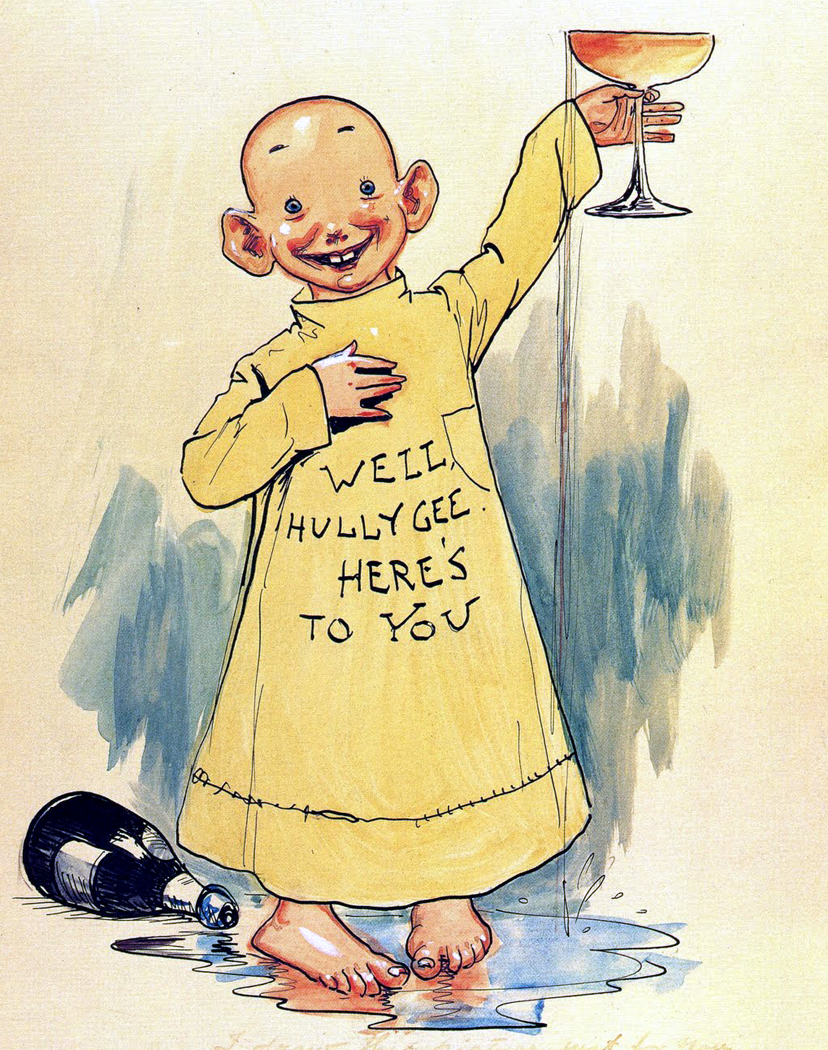
First, I think we should talk a bit about the rise of the graphic novel. Americans have been reading comics as long as there have been papers in circulation. But it was in 1895 when Richard Outcault's single panel cartoon, The Yellow Kid, that a comic became a popular culture icon. Newspapers realized that comics sold newspapers and so most then had a few strips in their pages.
It wasn't until the 1930s, though, that the first comic books were printed and sold. Two major publishing houses emerged--DC and Timely (which would become Marvel). It was around this time that the superheroes that still are found on our screens (and happy meals) were first born (or created by government scientists)--Superman, Batman, Wonderwoman, Captain America, Captain Marvel, and Plastic Man.
During the second World War, comic books featured patriotic heros. The major player was Captain America who, on the cover of his first issue, is knocking Hitler on his butt or in another issue almost takes the role of a Greek God. World War II was a golden age of comics because there were some "real" fighting to do and people loved to read these stories. But after the war, as America was enjoying "peace" and moving to the suburbs in droves, there didn't seem to be a need for superheroes anymore.
Then came EC Comics. EC first stood for Educational comics but in the fifties, the owner William Gianes, realizing that there were many young males (mostly) who would be interested in the dark side of 50s America, changed to Entertainment Comics and published Tales from the Crypt (not to be confused with the HBO series Tales from the Crypt or Creepshow or Tales from the Hood that were all spinoffs of the series). They also made Mad magazine (which has now been bought by DC comics). In the 1950s, though, as Mcarythism swirled, there was a fear that all this talk of zombies and flesh eating dead people (as well as the overt sexuality of the comics) was corrupting the youth of America and making them communists--so when psychiatrist Fredric Wertham published in 1954 Seduction of the Innocent that said that Comic books were too violent and sexual, publishers, fearing that they would be shut down, formed the Comic Magazine Association of America and toned down their comics.
What this did, of course, was open up spaces for smaller independent comic book writers and publishers to produce their own comics. Crude, rude and (mostly) roughly drawn, the most (in)famous of the writers was Robert Crumb who created Zap Comics (there is an interesting documentary about him entitled Crumb). These were certainly products of the sixties where there was a removal of societies taboos and a celebration of sex, drugs, masturbation, music (and of course, there was plenty of sexism and racism that went along with these comics as well).
But the major publishing houses did not disappear and in fact, they were also adapting their superheros to fit the times as well. Peter Parker was first bitten by a radioactive spider in Marvel's the Spectacular Spider Man. Here was a superhero who became one out of guilt and who always seemed to not get the girl (although in his spider suit, he was strong and brave and loved by mostly all).
But these were comic books--thought to be enjoyed only by adolescent boys and, for readers of alternative comics, perverts and burnouts. But in the 1970s, comics began to take themselves more seriously--and thus the birth of the graphic novel. One of the first graphic novels produced was Will Eisner's A CONTRACT WITH GOD AND OTHER TENEMENT STORIES. It's an interesting story about Jews living in the Bronx in the 1930s that did not shy away from issues dealing with religion as well as sex--inlcuding rape. These were not subjects found in the pages of Marvel or DC. Although this book was not that ground breaking in form, it did inspire many other writers who would take up the graphic novel form (including Art Spieglman who would pen Maus).
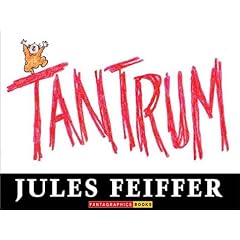
Jules Feiffer produced Tantrum, in 1979, bout a middle age man who is able to revert back to being a 4 year old in order to escape middle age responsibility. When his wife also learns this skill, they both become 4 years olds again so that they can escape their children and their responsibilities. While the subject matter was different from most, the drawing was also changing--it was quickly done with crudely drawn figures whose faces and bodies are exaggerated to fit a mood. Writers now were experimenting with both style and subjects and the graphic novel was a perfect form.
What the large publishing companies realized was that these books were not being read by gum chewing adolescent boys only but there was a varied group of consumers who wanted more complicated plots and more experimental drawings. Older heroes were revisited but were changed. Frank Miller's Daredevil (a blind lawyer whose senses were improved because of radiation) was previously a Spiderman knockoff, but with Miller at the helm, he made him into a warrior trained in martial arts who could understand the human condition. He also fell in love/lust with Elektra, a ninja assassin. What was apparent from this series was that the Comic Book code has loosened and comics were going to be telling stories that were a lot more seedier.
Frank Miller also created a novel in the mid 1980s-- a deeply dark and cynical Batman entitled Batman: The Dark Knight Returns.It was packaged for adult readers and the hero story was turned on its ear--Batman does save Gotham City but its a bleak world he saves. The government is useless at best and corrupt at worst and no one is going to save you because it's the right thing to do; they do it for the thrill. The colors were dark and the text disorienting--the world was dark and so were the graphic novel.
Around this time, Alan Moore also produced an important graphic novel that many in the class wrote about in their blogs--Watchmen. Much like Shooting War, it is a "what if..." book. In this fantasy world, Nixon has not been impeached, and all superheroes are outlawed. When the one superhero who the government still allows to work (because he is working on a nuclear experiment), is kidnapped, we find that most of the other superheroes who are still around are mortal, impotent and sometimes just plain crazy. DC comics held the rights to both Dark Knight and Watchmen and what these two books did was to bring the format to readers who normally wouldn't have been found in a comic book store. The form gained prestige.
In 1986, Art Spieglman broke from the super hero theme and produced MAUS: A Survivors Tale that told the enormously complicated story of his parents survival in Auschwitz as well as the authors own complicated relationship to his eccentric father. Millions read this book and while not everyone thought that the graphic form was a proper way to talk about the Holocaust, the second volume of the story earned Spegielman the Pulitzer Prize.
Since Maus to today, there are many well respected and well read graphic novels, including Ghost World, Palestine, Give it Up, The Death of Speedy, Jimmy Corrigan: The Smartest Kid on Earth, Adolf: The Tale of the Twentieth Century, etc. In the 90s and then in the 21st century, graphic novels became a marginalized part of the mainstream culture--check out the section in the Barnes and Noble on Court Street. Certainly not front and center of the store but it still does have a section that is filled with readers everytime I pass by. In 2002, for example, graphic novels sales grew by 23 percent--which is amazing when you look at how print media has declined in this century. Check out here for a list of current top graphic novel sellers.
Images of superheroes after 9/11. After 9/11, superheroes were once again battling "evil" but in this new world, many of the heroes didn't know exactly what/who to fight. Captain America, The Hulk are two examples.
Of course, one of the more recent examples of the graphic novel can be found in your hands right now: Shooting War. Images from the Book can be found here (with an interview by the author) and here.
Here are some ideas/thoughts that I want to bring up in class today.
The author's politics.
Is there any question about the author's politics? Anthony Lappe wrote a book entitled True Lies, which was pretty caustic response to the Iraq war and Dan Goldman (the illustrator) penned Everyman: Be the People, a satire of the presidency of George Bush. The politics about the war are pretty clearly seen in the video previewing the book. From the book their is this very upfront negative view of George Bush.
Do the overt political bias affect the way that you read this book? Does it just support your ideas that you had before reading? Go against them? Either way, did it add to your thoughts about the war or our current political situation in any way?
Is this book as "radical" as some of you suggested? Here's an expert from Mother Jones that I thought was interesting:
"For an audience who appreciates brisk pace, cool visuals, and entertainment-focused banter, I'd say they succeeded. But for a more critical, thoughtful analysis of the war and current American foreign policy, not so much. Shooting War is a wild, somewhat adolescent, ride through combat, imperialism, and capitalism that had me eagerly flipping pages, but ultimately craving more meaning beyond the crafty images and flippant dialog. But then again, Shooting War isn't The New York Times, and hard-hitting reporting and analysis was never the point of this project."
Portrayal of women in the book.
The "good" uploader
The Wicked reporter (1) The Wicked Reporter (2)
Sameera (serious)
Thoughts about global media
The Wicked Face
The sellout spiel
Not seen in the graphic novel
Fox News
The form of the graphic novel.
Corporate Influence
Depictions of violence.
Shooting of soldiers
Cutting off the head of the "infidel"
Images of soldiers.
Shooting unarmed man (Vietnam reference?)
Media representation of the "hero" figure
Jimmy labeled a hero
Jimmy as egotistical hipster
The reformed Jimmy still cares about himself
Okay, that's just a few but hopefully you will bring up the images/ideas that you wnat to talk about.......
See you in class!