Yesterday, when I was ordering coffee in Greenpoint, Brooklyn, I met a friendly older Polish man who asked me in a mixture of English and hand signals, what I did for a living. I told him that I was an English professor. He stood up straight and with a large smile said, "ahh! You teach Shakespeare?" He was so happy and said that "kids learn, um, from the Master." His wife who was standing next to me then informed me that when they came over from Poland, they had to leave a lot of their stuff at home but they took Shakespeare's plays with them when they immigrated.
I didn't tell them that we were going to spend my literature class talking about a comic book. I think the older man might have thrown coffee in my face.
But after reading many of your posts, it seems like most of you will not be throwing coffee at me and, in fact, you enjoyed or were pleasantly disturbed by your reading. Great. And I will try to let the discussions run where they will in this class, so I am hoping that you will come in with plenty of ideas that you want to pas around.
But, of course, there are things that I think we need to do first to contextualize SHOOTING WAR and then there are certain subjects that I think we certainly need to discuss.
The GRAPHIC NOVEL (I read as much as I could about the graphic novel for this class including Stephen Weiner's The Rise of the Graphic Novel).
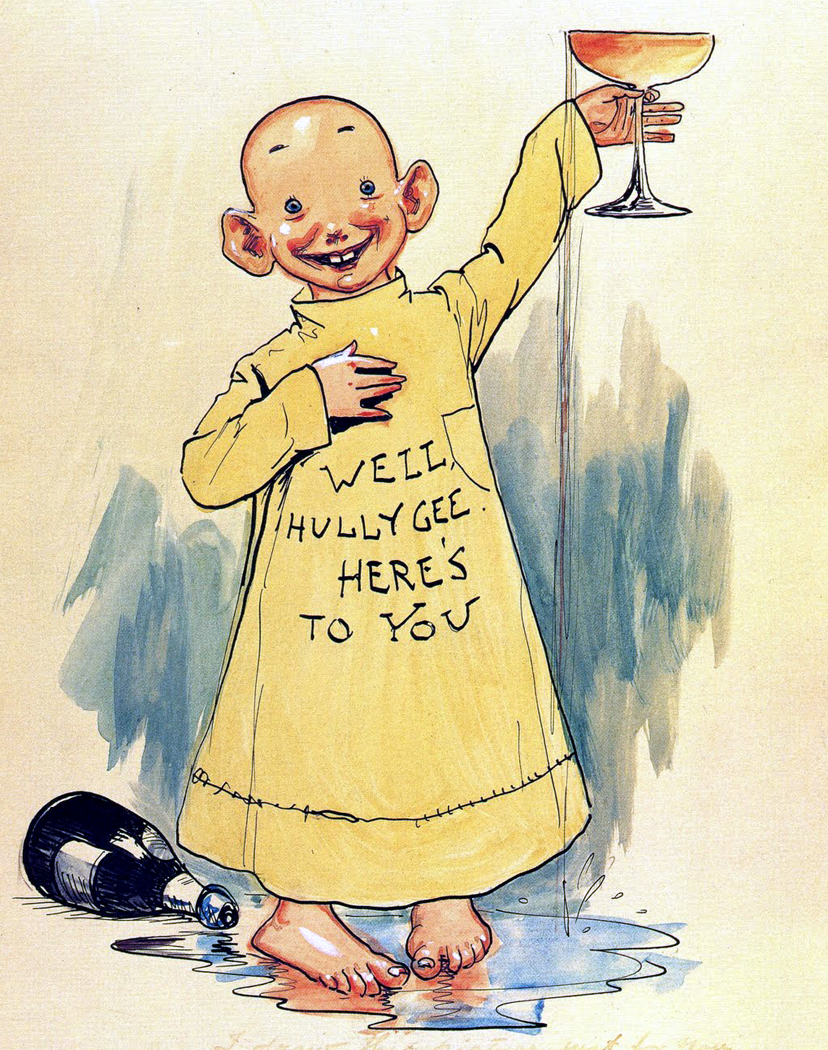
First, I think we should talk a bit about the rise of the graphic novel. Americans have been reading comics as long as there have been papers in circulation. But it was in 1895 when Richard Outcault's single panel cartoon, The Yellow Kid, that a comic became a popular culture icon. Newspapers realized that comics sold newspapers and so most then had a few strips in their pages.
It wasn't until the 1930s, though, that the first comic books were printed and sold. Two major publishing houses emerged--DC and Timely (which would become Marvel). It was around this time that the superheroes that still are found on our screens (and happy meals) were first born (or created by government scientists)--Superman, Batman, Wonderwoman, Captain America, Captain Marvel, and Plastic Man.
During the second World War, comic books featured patriotic heros. The major player was Captain America who, on the cover of his first issue, is knocking Hitler on his butt or in another issue almost takes the role of a Greek God. World War II was a golden age of comics because there were some "real" fighting to do and people loved to read these stories. But after the war, as America was enjoying "peace" and moving to the suburbs in droves, there didn't seem to be a need for superheroes anymore.
Then came EC Comics. EC first stood for Educational comics but in the fifties, the owner William Gianes, realizing that there were many young males (mostly) who would be interested in the dark side of 50s America, changed to Entertainment Comics and published Tales from the Crypt (not to be confused with the HBO series Tales from the Crypt or Creepshow or Tales from the Hood that were all spinoffs of the series). They also made Mad magazine (which has now been bought by DC comics). In the 1950s, though, as Mcarythism swirled, there was a fear that all this talk of zombies and flesh eating dead people (as well as the overt sexuality of the comics) was corrupting the youth of America and making them communists--so when psychiatrist Fredric Wertham published in 1954 Seduction of the Innocent that said that Comic books were too violent and sexual, publishers, fearing that they would be shut down, formed the Comic Magazine Association of America and toned down their comics.
What this did, of course, was open up spaces for smaller independent comic book writers and publishers to produce their own comics. Crude, rude and (mostly) roughly drawn, the most (in)famous of the writers was Robert Crumb who created Zap Comics (there is an interesting documentary about him entitled Crumb). These were certainly products of the sixties where there was a removal of societies taboos and a celebration of sex, drugs, masturbation, music (and of course, there was plenty of sexism and racism that went along with these comics as well).
But the major publishing houses did not disappear and in fact, they were also adapting their superheros to fit the times as well. Peter Parker was first bitten by a radioactive spider in Marvel's the Spectacular Spider Man. Here was a superhero who became one out of guilt and who always seemed to not get the girl (although in his spider suit, he was strong and brave and loved by mostly all).
But these were comic books--thought to be enjoyed only by adolescent boys and, for readers of alternative comics, perverts and burnouts. But in the 1970s, comics began to take themselves more seriously--and thus the birth of the graphic novel. One of the first graphic novels produced was Will Eisner's A CONTRACT WITH GOD AND OTHER TENEMENT STORIES. It's an interesting story about Jews living in the Bronx in the 1930s that did not shy away from issues dealing with religion as well as sex--inlcuding rape. These were not subjects found in the pages of Marvel or DC. Although this book was not that ground breaking in form, it did inspire many other writers who would take up the graphic novel form (including Art Spieglman who would pen Maus).
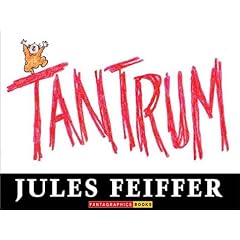
Jules Feiffer produced Tantrum, in 1979, bout a middle age man who is able to revert back to being a 4 year old in order to escape middle age responsibility. When his wife also learns this skill, they both become 4 years olds again so that they can escape their children and their responsibilities. While the subject matter was different from most, the drawing was also changing--it was quickly done with crudely drawn figures whose faces and bodies are exaggerated to fit a mood. Writers now were experimenting with both style and subjects and the graphic novel was a perfect form.
What the large publishing companies realized was that these books were not being read by gum chewing adolescent boys only but there was a varied group of consumers who wanted more complicated plots and more experimental drawings. Older heroes were revisited but were changed. Frank Miller's Daredevil (a blind lawyer whose senses were improved because of radiation) was previously a Spiderman knockoff, but with Miller at the helm, he made him into a warrior trained in martial arts who could understand the human condition. He also fell in love/lust with Elektra, a ninja assassin. What was apparent from this series was that the Comic Book code has loosened and comics were going to be telling stories that were a lot more seedier.
Frank Miller also created a novel in the mid 1980s-- a deeply dark and cynical Batman entitled Batman: The Dark Knight Returns.It was packaged for adult readers and the hero story was turned on its ear--Batman does save Gotham City but its a bleak world he saves. The government is useless at best and corrupt at worst and no one is going to save you because it's the right thing to do; they do it for the thrill. The colors were dark and the text disorienting--the world was dark and so were the graphic novel.
Around this time, Alan Moore also produced an important graphic novel that many in the class wrote about in their blogs--Watchmen. Much like Shooting War, it is a "what if..." book. In this fantasy world, Nixon has not been impeached, and all superheroes are outlawed. When the one superhero who the government still allows to work (because he is working on a nuclear experiment), is kidnapped, we find that most of the other superheroes who are still around are mortal, impotent and sometimes just plain crazy. DC comics held the rights to both Dark Knight and Watchmen and what these two books did was to bring the format to readers who normally wouldn't have been found in a comic book store. The form gained prestige.
In 1986, Art Spieglman broke from the super hero theme and produced MAUS: A Survivors Tale that told the enormously complicated story of his parents survival in Auschwitz as well as the authors own complicated relationship to his eccentric father. Millions read this book and while not everyone thought that the graphic form was a proper way to talk about the Holocaust, the second volume of the story earned Spegielman the Pulitzer Prize.
Since Maus to today, there are many well respected and well read graphic novels, including Ghost World, Palestine, Give it Up, The Death of Speedy, Jimmy Corrigan: The Smartest Kid on Earth, Adolf: The Tale of the Twentieth Century, etc. In the 90s and then in the 21st century, graphic novels became a marginalized part of the mainstream culture--check out the section in the Barnes and Noble on Court Street. Certainly not front and center of the store but it still does have a section that is filled with readers everytime I pass by. In 2002, for example, graphic novels sales grew by 23 percent--which is amazing when you look at how print media has declined in this century. Check out here for a list of current top graphic novel sellers.
Images of superheroes after 9/11. After 9/11, superheroes were once again battling "evil" but in this new world, many of the heroes didn't know exactly what/who to fight. Captain America, The Hulk are two examples.
Of course, one of the more recent examples of the graphic novel can be found in your hands right now: Shooting War. Images from the Book can be found here (with an interview by the author) and here.
Here are some ideas/thoughts that I want to bring up in class today.
The author's politics.
Is there any question about the author's politics? Anthony Lappe wrote a book entitled True Lies, which was pretty caustic response to the Iraq war and Dan Goldman (the illustrator) penned Everyman: Be the People, a satire of the presidency of George Bush. The politics about the war are pretty clearly seen in the video previewing the book. From the book their is this very upfront negative view of George Bush.
Do the overt political bias affect the way that you read this book? Does it just support your ideas that you had before reading? Go against them? Either way, did it add to your thoughts about the war or our current political situation in any way?
Is this book as "radical" as some of you suggested? Here's an expert from Mother Jones that I thought was interesting:
"For an audience who appreciates brisk pace, cool visuals, and entertainment-focused banter, I'd say they succeeded. But for a more critical, thoughtful analysis of the war and current American foreign policy, not so much. Shooting War is a wild, somewhat adolescent, ride through combat, imperialism, and capitalism that had me eagerly flipping pages, but ultimately craving more meaning beyond the crafty images and flippant dialog. But then again, Shooting War isn't The New York Times, and hard-hitting reporting and analysis was never the point of this project."
Portrayal of women in the book.
The "good" uploader
The Wicked reporter (1) The Wicked Reporter (2)
Sameera (serious)
Thoughts about global media
The Wicked Face
The sellout spiel
Not seen in the graphic novel
Fox News
The form of the graphic novel.
Corporate Influence
Depictions of violence.
Shooting of soldiers
Cutting off the head of the "infidel"
Images of soldiers.
Shooting unarmed man (Vietnam reference?)
Media representation of the "hero" figure
Jimmy labeled a hero
Jimmy as egotistical hipster
The reformed Jimmy still cares about himself
Okay, that's just a few but hopefully you will bring up the images/ideas that you wnat to talk about.......
See you in class!




1 comment:
Yes, Polish people.
Post a Comment